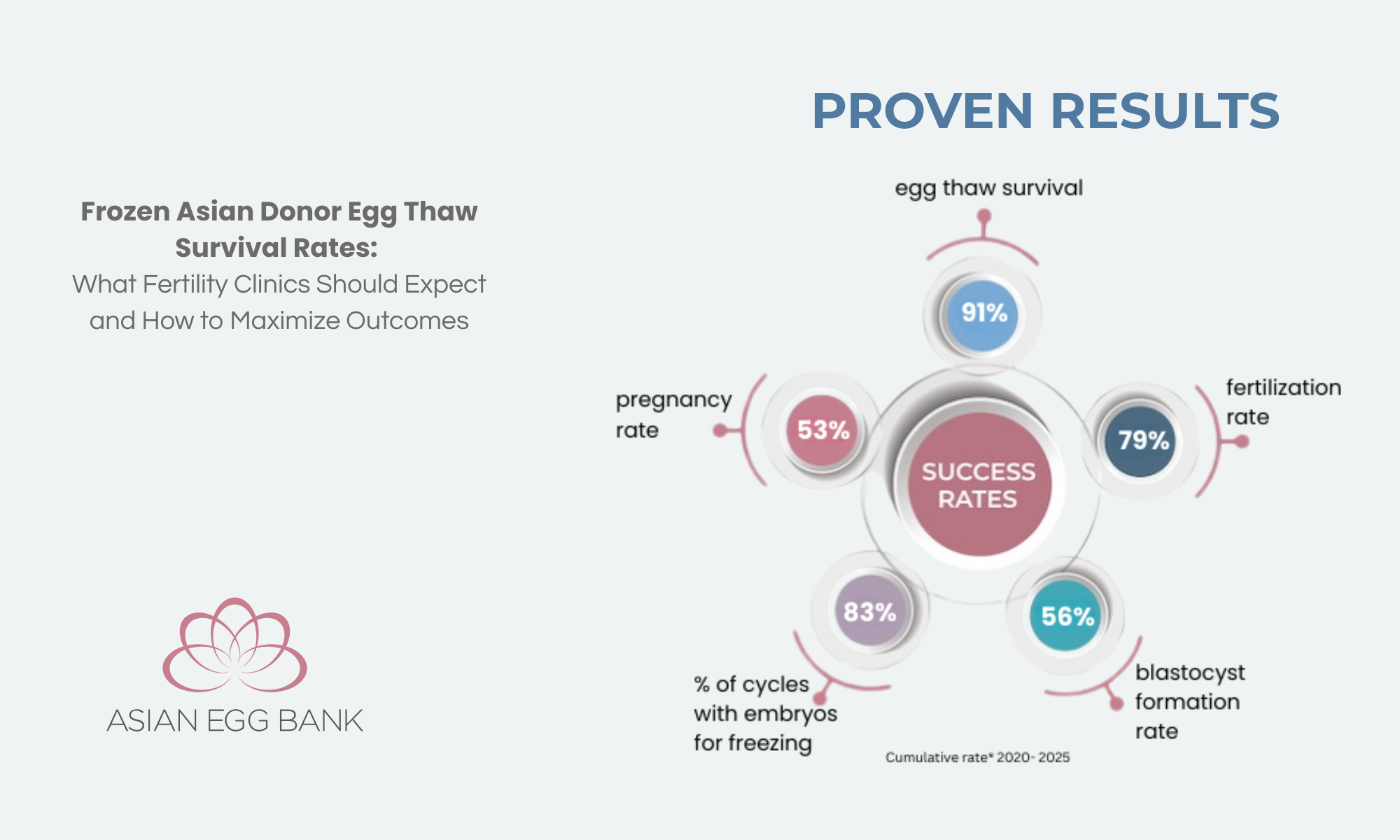
For reproductive endocrinologists and embryology teams working with frozen donor eggs, one question comes up consistently during the evaluation process: what thaw survival rates can we realistically expect? It is a fair and essential question. The clinical and financial success of a frozen donor egg cycle depends heavily on how many mature oocytes survive the warming process in a viable, fertilizable state.
At Asian Egg Bank, we understand that fertility clinics need reliable data, not aspirational numbers. This article walks through what thaw survival rates actually mean, the key variables that influence them, what clinics can expect when working with AEB frozen donor eggs, and how to position each cycle for the best possible outcome.
What Thaw Survival Rates Actually Mean
Thaw survival rate refers to the percentage of vitrified mature oocytes that survive the warming process intact and ready for fertilization. In clinical practice, an egg is considered "survived" when it retains its structural integrity after warming — specifically, when it has not undergone lysis, fragmentation, or degeneration that would make it non-viable for ICSI (intracytoplasmic sperm injection).
This is distinct from fertilization rate, blastocyst development rate, or live birth rate, though all of these metrics are downstream variables affected by oocyte quality and survival. A strong thaw survival rate is the first prerequisite in a successful frozen egg cycle — without it, even the best embryology team has limited material to work with.
Industry benchmarks for mature oocyte thaw survival typically range from 80 to 90 percent, though rates vary significantly based on the quality of the cryopreservation protocol, the donor's individual response, the experience of the vitrification laboratory, and how eggs are handled upon receipt.
AEB's Vitrification Protocol and Lab Standards
Asian Egg Bank uses a standardized vitrification protocol developed and refined over years of working exclusively with Asian and Asian-American egg donors. Our cryopreservation process follows strict laboratory standards aligned with current best practices in reproductive medicine, including the use of closed vitrification systems, controlled cooling rates, and rigorous quality checks at every stage.
Our laboratory team vitrifies mature (MII) oocytes only. Immature eggs are not included in shipment, ensuring that every egg in a lot represents a viable candidate for fertilization. Quality assurance checkpoints occur both before and after vitrification to confirm oocyte morphology and integrity.
Eggs are shipped in secure dry vapor nitrogen tanks, maintained at stable cryogenic temperatures throughout transit, and packaged to meet both domestic and international biosafety transport standards. We provide detailed documentation with each shipment, including the donor's stimulation protocol, total eggs retrieved, total MII eggs vitrified, and lot-specific quality notes.
What Thaw Survival Rates Can Clinics Expect from AEB?
Asian Egg Bank's frozen donor eggs consistently achieve thaw survival rates within the high-performance range seen at leading fertility programs. While individual outcomes can vary based on clinic-side protocols, our eggs are prepared to industry-leading standards that position them for strong performance.
For clinics considering working with AEB, we recommend reviewing our detailed outcome data — including fertilization rates, blastocyst development rates, and pregnancy outcomes from authorized center partners — which is available to qualified clinics through our professional portal. To explore the most current outcome data and what it means for your patient population, visit our success rate page for professionals.
It is worth noting that frozen donor egg outcomes at AEB are benchmarked against a patient population that is often underserved by general egg banks. Asian patients seeking genetically matched donors face a significantly smaller donor pool at most egg banks. AEB exists specifically to fill this gap, and our outcomes reflect both the quality of our donors and the care we put into every phase of the process.
Factors That Influence Thaw Survival Rates
Even with a high-quality vitrification protocol, several variables can affect thaw survival. Understanding these factors helps clinic teams anticipate outcomes and troubleshoot if needed.
Donor Age and Ovarian Reserve
Younger donors with strong ovarian reserve tend to produce more eggs per stimulation cycle and eggs that are more resilient through cryopreservation and warming. AEB donors are screened rigorously for age, AMH levels, antral follicle count, and overall reproductive health before acceptance into the program.
Stimulation Protocol
The hormonal protocol used during stimulation affects oocyte quality. Over-response (high follicle counts, very high estradiol) and under-response both carry risks for oocyte quality. AEB's medical team monitors each donor closely throughout the cycle and adjusts protocols proactively to optimize for egg quality rather than quantity alone.
Time from Retrieval to Vitrification
Minimizing the window between egg retrieval and vitrification reduces the risk of degradation. Our in-house laboratory team performs same-day vitrification immediately following retrieval and oocyte maturity assessment.
"We vitrify only mature MII oocytes, and every lot undergoes rigorous quality checks before it leaves our laboratory," says Dr. LeBlanc. "When partner clinics follow our warming protocol precisely, we consistently see survival rates that reflect that level of care."
Receiving Clinic Warming Protocol
Once eggs arrive at your clinic, the warming protocol used by your embryology team plays a critical role. AEB provides detailed warming guidelines with every shipment and is available to consult with your lab team as needed. Consistency with the warming reagents, temperature management, and timing specified in our protocol is associated with the best survival outcomes.
Maximizing Outcomes: Best Practices for Receiving Clinics
Working with frozen donor eggs from AEB is a collaborative process. We supply the eggs; your team handles the warming, ICSI, culture, and transfer. To get the most out of every lot, here are practices that consistently support strong results:
Follow the AEB warming protocol precisely. Variations in warming reagent temperature, exposure time, or handling technique can affect survival. Our protocol is provided with each shipment and is available in advance for your embryology team to review.
Coordinate timing carefully. Align egg warming with your recipient's endometrial preparation so that the embryo transfer timeline is optimized. AEB's team can advise on preferred timing windows based on how our eggs perform through the culture phase.
Use ICSI exclusively. All frozen donor egg cycles should use ICSI rather than conventional IVF. This is standard practice and particularly important for cryopreserved eggs, where zona hardening can impair fertilization via conventional insemination.
Culture to blastocyst. Extended culture to the blastocyst stage (Day 5 or 6) allows for natural selection of the highest quality embryos and supports better implantation rates compared to Day 3 transfers in most clinical contexts.
Consider preimplantation genetic testing. For patients where it is clinically indicated, PGT-A (preimplantation genetic testing for aneuploidy) can help identify euploid blastocysts and may improve the probability of a successful transfer.
The Authorized Center Program: How AEB Supports Partner Clinics
Asian Egg Bank operates an Authorized Center program for fertility clinics committed to providing high-quality frozen Asian donor egg cycles to their patients. Becoming an Authorized Center is not just about purchasing eggs — it is a partnership that comes with dedicated clinical support, access to exclusive donor lots, priority allocation during high-demand periods, and direct communication with our medical and scientific team.
Authorized Centers also benefit from AEB's ongoing quality improvement initiatives, including protocol sharing, outcome benchmarking, and access to education resources for both clinical staff and patients. To learn more about what it means to partner with AEB as an Authorized Center, visit our authorized centers page.
Getting Started: The Onboarding Process
We designed our clinic onboarding process to be as simple and efficient as possible. We understand that your team's time is valuable and that adding a new vendor relationship needs to fit into an already busy workflow. From initial inquiry to receiving your first lot of eggs, AEB's onboarding is built to move quickly without sacrificing thoroughness.
The process includes a clinical consultation with our team to review your patient population and case types, verification of your laboratory's compliance with applicable standards, a review of our donor catalog and available lots, and coordination of your first order. Most clinics are up and running with their first AEB cycle within a few weeks of beginning the process.
"Our goal is to make every partnership as smooth as possible for the clinic team," says Dr. Chang. "We stay available throughout the entire cycle — not just at shipment — because the best outcomes come from close coordination between our laboratory and the clinic's embryology team."
To get started, visit our easy onboarding page for professionals and submit an inquiry. A member of our clinical partnerships team will follow up promptly.
Frequently Asked Questions
What thaw survival rate should we expect per lot?
While individual outcomes can vary, AEB frozen donor eggs consistently perform within the high-performance range for vitrified mature oocytes in clinical use. Specific outcome data is available through our professional portal. Contact our team to request access.
How many eggs come in a lot?
AEB lots typically contain a set number of mature vitrified oocytes. The specific lot size can vary by donor and cycle. Our team will provide complete lot details — including the number of MII eggs vitrified — prior to your purchase so your team can plan accordingly.
Can we review donor stimulation records and hormone levels?
Yes. AEB provides detailed clinical documentation with every lot, including relevant cycle and stimulation information to support your clinical planning and patient counseling.
Do you offer a guarantee or replacement policy?
AEB stands behind the quality of every lot we ship. Please contact our clinical partnerships team directly to discuss our quality assurance policies and any available protections relevant to your clinic's situation.
Do you ship internationally?
Yes. AEB ships frozen donor egg lots domestically and internationally to qualified authorized centers. Our team coordinates all logistics, documentation, and customs compliance for international orders.
What happens if our embryology team has questions during the warming process?
AEB provides direct support to partner clinic embryology teams. We are available by phone and email to address warming protocol questions, troubleshoot unexpected outcomes, and provide guidance throughout the cycle process.
Partner with Asian Egg Bank for Your Patients Who Need Asian Donor Eggs
Asian Egg Bank exists to make it possible for fertility clinics to offer their Asian patients a real path to genetically matched family building. With a dedicated donor pool, rigorous quality standards, and a collaborative approach to clinical partnership, AEB is the resource your clinic has been looking for.
If you are ready to learn more about our frozen donor egg lots, our outcome data, or how to become an Authorized Center partner, reach out to our team today. We look forward to supporting your patients with the care and expertise they deserve.






.png)
.jpg)